If you are reading this, you are probably worried about a parent. Maybe you have noticed them slowing down, or had a phone call after a stumble, or you are simply trying to plan ahead. The good news: most older adults can stay at home for years longer than they expect, given the right small changes. This is a practical guide to spotting what is needed, having the conversation, and acting on it.
Quick answer
Start by watching for changes in routine, not just changes in ability. Have the conversation early, while it is still preventative. Get an Occupational Therapy assessment from the council (free), make small adaptations first (lighting, grab rails, shower seat), and address stairs before they become a real problem. For a free no-obligation home survey anywhere in Scotland, call 0800 776 5404.
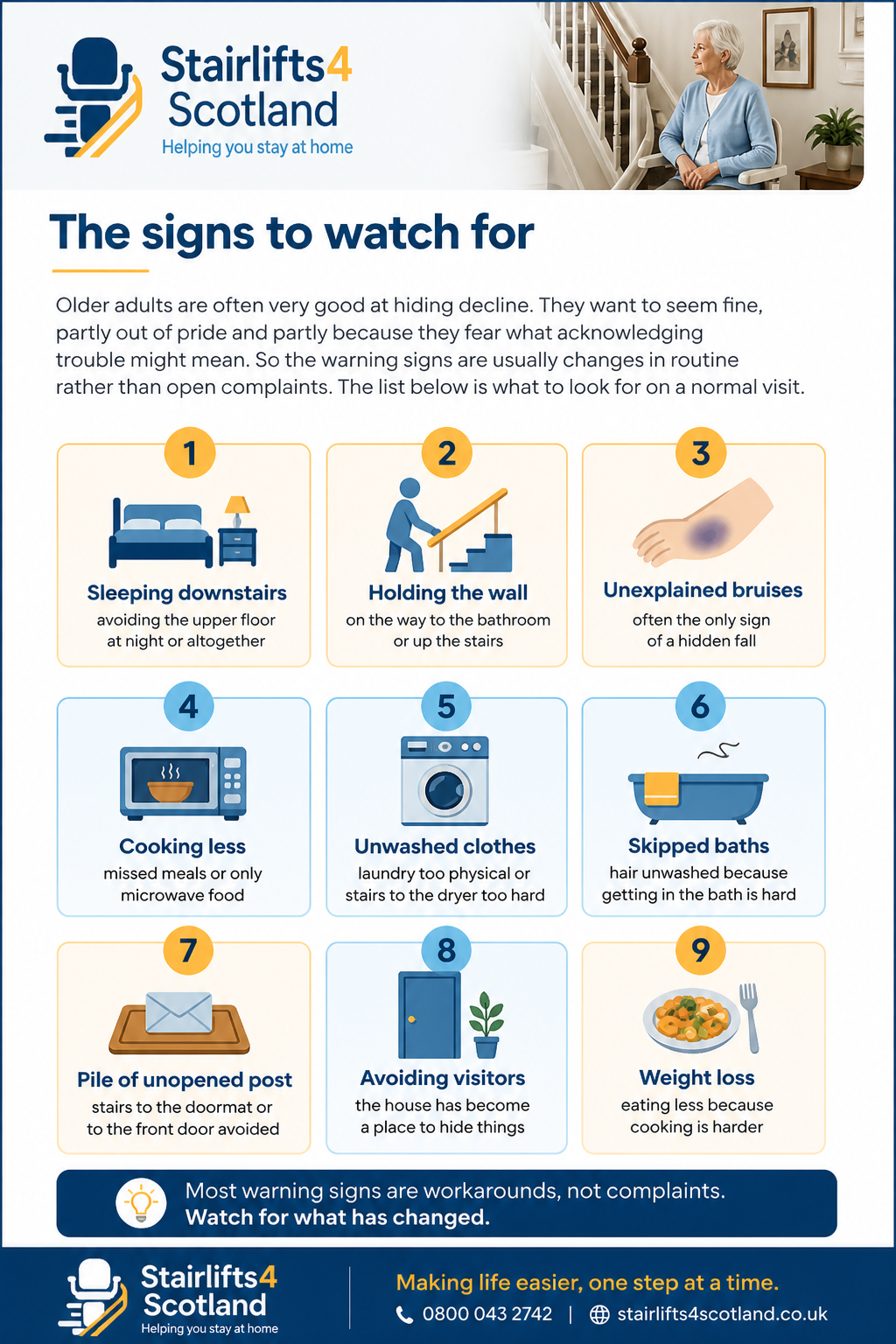
The signs to watch for
Older adults are often very good at hiding decline. They want to seem fine, partly out of pride and partly because they fear what acknowledging trouble might mean. So the warning signs are usually changes in routine rather than open complaints. The list below is what to look for on a normal visit.
Having the conversation
This is the part most people dread. The temptation is to turn up with a plan and a leaflet, but that almost never works. The conversation works better as a series of smaller ones over weeks or months.
A few principles that help:
- Start with their world, not your worry. Ask how things are going, what is harder than it used to be, what they miss doing. Listen to the answer.
- Frame adaptations as enabling, not disabling. "A stairlift would mean you could use the back bedroom again" lands better than "You can't manage the stairs anymore."
- Lead with their priorities. If they want to keep the garden, talk about how an outdoor stairlift to the patio would help. If they miss having grandchildren over, talk about the spare room.
- Avoid the word 'safety' too early. It triggers defensiveness. 'Easier' lands better.
- Use a third voice when you can. A GP, an OT, a friend who has had the same thing done, or even an article like this one. Children's worry is dismissable in a way that a professional's recommendation is not.
- Be patient with refusal. The first 'no' is rarely the final answer. Keep visiting, keep listening, and let the practical reality do the persuading.
The room-by-room safety walk
Once your parent is at least open to the idea, the most useful next step is a walk around the home together, looking specifically for what could be made easier. Below is a checklist that covers the basics. Bring a notebook.
The stairs
Are both sides supported by a strong handrail? Is the top step clearly visible? Is the stairwell well-lit, especially in the evening? Has your parent stopped using the upstairs at all, or only sometimes? If they pause halfway up, that is the most reliable single signal that a stairlift would change their daily life.
The bathroom
Stepping into a bath is the most dangerous routine task in any older home. If your parent has stopped having baths, that is not a preference, it is an avoidance. A walk-in shower or wet room is one of the highest-impact changes you can make. While you are there, look at the toilet height (a raised seat helps), grab rails next to the toilet and shower, and the floor surface (non-slip mats or non-slip flooring).
The kitchen
Is the kettle full at all times (because lifting it is the problem)? Is the bread on the worktop because the bread bin is too low? Are the most-used pans on top of the cooker rather than in cupboards? These are the visible workarounds. Adaptations like lever taps, a kettle tipper, and a perch stool make a real difference.
The bedroom
Is the bed at the right height? When your parent sits on it, can they put both feet flat on the floor with their thighs roughly horizontal? A bed too low or too high is hard to get out of. Bed risers fix the first; a lower base fixes the second. Is there a clear path from bed to bathroom for night trips, with a nightlight on the route? Falls at three in the morning are common and preventable.
Lighting throughout
Older eyes need significantly more light to see well. Replace 40W bulbs with bright LED equivalents (2700K to 3000K is warm and easy on the eyes). Add motion-sensor plug-in lights at the top and bottom of the stairs and on the route to the bathroom.
Getting professional help
Adult children often try to do everything themselves. They do not need to. Scotland has a generous network of free professional support, but you have to ask for it. The main routes are:
Occupational Therapy through the council
Phone the local council where your parent lives and ask for an Occupational Therapy assessment under the Scheme of Assistance. The OT visits, watches your parent move through the home, and recommends both equipment and adaptations. The assessment is free. Either you or your parent can request it. Be aware of waiting times, which vary from a few weeks to several months depending on area.
Care and Repair Scotland
A network of local agencies (the names vary by council) that help older homeowners and private tenants plan, organise, and oversee adaptations. They are independent of the council and good at helping if the council process is taking too long or if your parent owns their home and wants to handle things privately. Search "Care and Repair" plus the council name to find the local agency.
Age Scotland helpline
0800 12 44 222. Free national helpline covering benefits, housing, and care. They are good for orienting yourself early in the process and for working out what funding might apply.
The GP
An underused resource. A GP can refer for community physiotherapy, falls assessment, and other specialist services that families do not always know exist. They can also have the harder conversations with your parent about declining ability when family members cannot.
When stairs become the priority
For most older adults staying at home, stairs are the single biggest risk and the single biggest barrier to independence. They are also the easiest thing to fix.
A modern stairlift solves the problem completely. Reconditioned models can be fitted within a day or two of a survey. They have nothing to do with the stair carpet or the wall (the rail bolts to the treads), and they can be removed cleanly when no longer needed. For a parent who has stopped going upstairs, the change of life is profound. They get their bedroom back, their study, their loft, the spare room.
If you are in this position, start with a free home survey. Our surveyors visit anywhere in Scotland, measure the stairs, recommend a model, and give a written quote. There is no obligation and your parent can think it over for as long as they want. The survey itself, importantly, is also a useful conversation: many parents who are not yet ready to commit decide to go ahead a few weeks later, once the idea has had time to settle.
Looking after yourself
Adult children who help an elderly parent are the silent backbone of social care in Scotland. The practical and emotional load is heavy and almost always underestimated by everyone except the people doing it.
A few things that help:
- Tell siblings and other family what is going on. Caring is rarely fair, but it is often more shareable than it looks once it is being talked about.
- Use the professional services. The OT, the GP, Age Scotland, Care and Repair: that is what they are there for, and they will not think you are over-reacting.
- Look into Carer's Allowance if you are providing more than 35 hours a week of unpaid care. mygov.scot has the details for Scotland.
- Make the decisions you can make today. Waiting for things to be settled before acting often means waiting forever. Lighting, grab rails, a stairlift survey: these are reversible, low-stakes choices. They do not commit anyone to anything.
Frequently asked questions
How do I bring up the subject of a stairlift with my parent?
Start by asking about their day, not their decline. Notice what they have stopped doing (going upstairs at night, having a bath rather than a shower, missing post that's arrived) and ask if those changes were a choice or a workaround. Then offer the adaptation as a way to do more, not less. "A stairlift would mean you could use the back bedroom again" lands very differently from "You can't manage the stairs."
What are the early warning signs that my parent needs adaptations?
Watch for changes in routine more than changes in mobility. Sleeping in the living room, avoiding the upper floor, holding the wall on the way to the bathroom, missing meals because cooking has become awkward, and unexplained bruises are all signals. So is a sudden reluctance to have visitors. Most older adults manage decline by quietly working around it; the workarounds are the warning sign.
How do I get my parent assessed for funded help?
Phone your parent's local council and ask for a Community Care Assessment from social work, plus an Occupational Therapy assessment. Both are free and either you or your parent can request them. The OT visits the home, watches your parent move around, and recommends adaptations and equipment. Council waiting lists vary; expect anywhere from a few weeks to several months, longer in cities.
My parent refuses to accept they need help. What do I do?
This is the hardest part. Refusal is almost always rooted in fear of losing control, fear of being moved into care, or fear of being a burden. Pushing harder rarely works. Listening, framing adaptations as an alternative to moving, and using a third party (GP, OT, family friend) as the messenger often does. Sometimes it takes a small fall before resistance softens. Stay close, do not retreat, and keep the door open.
Can my parent stay at home if they have early dementia?
In the early and middle stages, yes, with the right support. Familiar surroundings are protective for someone with dementia. Adaptations matter more than usual: clear routes, contrast on stair edges, locks on cookers and front doors that prevent wandering, and good lighting throughout. A stairlift is a particular help because stairs become disorientating. The point at which home is no longer the right place varies hugely; your parent's GP and OT are the right people to discuss it with.
Worried about a parent on the stairs? Book a free home survey or call 0800 776 5404. We are happy to talk through options with you on the phone first if your parent is not ready to commit. No pressure, no obligation.
We cover all of Scotland including Glasgow, Edinburgh, Aberdeen, Stirling, Motherwell, Greenock and Johnstone.