Standing Stairlifts
Standing and Perch Stairlifts
A stairlift you stand on and lean against, instead of sitting in. It suits very narrow stairs, and people who find it painful to bend their knees or hips.
In short
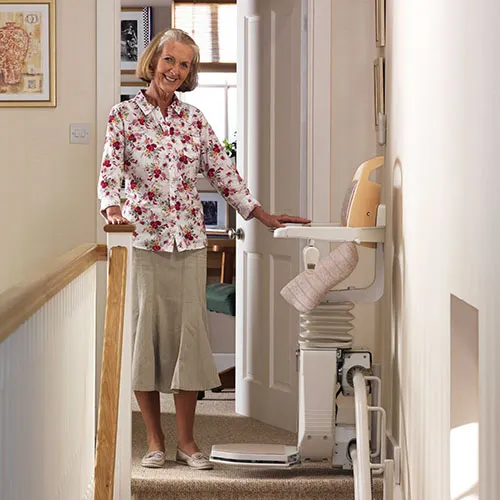
A standing stairlift, also called a perch or percher stairlift, carries you up the stairs upright. You stand on the footrest and lean back on a small raised seat, held by a seat belt. It takes up less of the staircase than a seated stairlift, but you need to be steady on your feet to use one.
How It Works
What Is a Standing Stairlift?
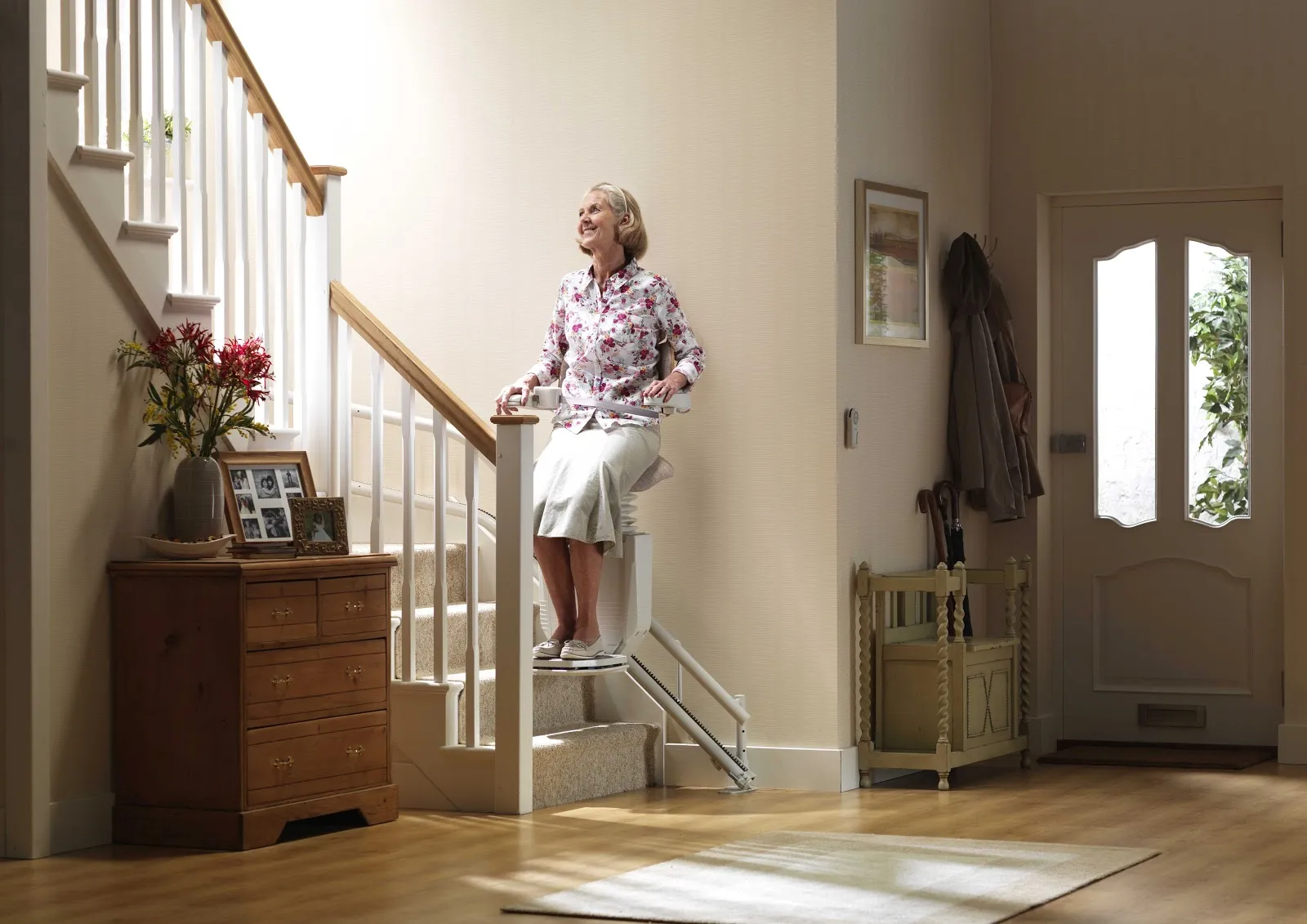
In most ways it is the same as any other stairlift. The rail is fixed to the stair treads, not the wall. It runs on rechargeable batteries, so it keeps working in a power cut. You control it with a simple switch on the armrest.
The difference is the seat. On a standing stairlift the seat is shorter and set higher, so you perch against it with your legs almost straight. You are not lowering yourself down into a chair and pushing back up again at the other end.
That makes two things possible. People with stiff or painful knees and hips can use the stairs without bending far. And because your knees do not project across the staircase, it can fit on stairs that are too narrow for a seated stairlift.
Is It Right for You?
Who a Standing Stairlift Suits
Stiff or painful knees and hips
If sitting down low and getting back up is the hard part, for example with severe arthritis, a raised perch seat means you hardly bend at all.
Very narrow stairs
Where a seated stairlift would be too wide, a standing one can still fit, because you take up less room standing than sitting.
Stairs other people use too
The seat, arms and footrest fold up when the stairlift is parked, leaving the stairs clear for everyone else in the house.
Who it does not suit
You are on your feet for the whole journey, so you need reasonable balance. If you get dizzy, feel faint or are unsteady when standing, a seated stairlift is the safer choice. Where you can sit comfortably and the stairs are wide enough, we will usually recommend a seated stairlift first.
Headroom matters too. You ride more upright than on a seated stairlift, so there has to be enough height all the way up, particularly under a low ceiling. We check this at the home visit.
Compare
Standing or Seated?
| Standing (perch) stairlift | Seated stairlift | |
|---|---|---|
| How you ride | Standing, leaning on a raised seat | Sitting down |
| Best for | Painful knees or hips, very narrow stairs | Most people and most staircases |
| Room on the stairs | Needs less width | Needs around 28 to 29 inches (71 to 74cm) |
| Headroom | Needs more, as you ride upright | Needs less |
| Balance | You must be steady on your feet | Suitable if balance is poor |
Getting a Standing Stairlift Fitted
It starts with a free home visit. We measure the staircase at its narrowest point, check the headroom from top to bottom, and look at where you would get on and off. We also talk through how you manage on your feet, because that decides whether a standing or a seated stairlift is right for you.
If you would like an idea of what is possible first, send us a few photos of your stairs and we can often advise by phone or WhatsApp.
Most standing stairlifts are fitted on straight stairs. Whether one will suit a staircase with a turn depends on the stairs, so ask us and we will tell you plainly. If you would prefer a reconditioned stairlift, tell us and we will check what is available.
You get a clear written quote with no hidden extras and no obligation. As with every stairlift we fit, it is fully guaranteed, and there is no structural work and no mess.
Stairs narrow but not sure a standing stairlift is the answer? Our guide to stairlifts for narrow stairs covers slim seated models and how to measure your staircase.
Standing Stairlifts - Common Questions
What is the difference between a standing stairlift and a perch stairlift?
They are two names for the same kind of stairlift. You may also see it called a percher or a sit-stand stairlift. Instead of sitting down, you stand on the footrest and lean back against a small, raised seat.
Is a standing stairlift safe?
Yes, for the right person. You are held by a seat belt with an armrest on either side, and the stairlift stops by itself if it meets something on the stairs, just as a seated stairlift does. You do need to be steady on your feet for the length of the journey. If balance or dizziness is a concern, a seated stairlift is the safer choice and we will tell you so.
How narrow can the stairs be for a standing stairlift?
A standard seated stairlift needs a staircase around 28 to 29 inches (71 to 74cm) wide. A standing stairlift can work where a seated one would be too wide, because your knees do not project across the stairs. The exact figure depends on the model, so we measure your stairs at the free home visit. Our guide to stairlifts for narrow stairs shows how to measure them yourself.
Can I get a grant or VAT relief on a standing stairlift?
The same help applies as for any stairlift. Stairlifts are VAT-free for people with a long-term illness or disability, and Scottish councils can help with the cost through the Scheme of Assistance where an occupational therapist assesses a stairlift as essential. See our grants guide and our VAT relief guide.
Find Your Local Number
Type your postcode and we will show you the local number for your area. A colleague close to you will arrange your free home visit.
Areas we cover
See every area and local number · Or call free from anywhere in Scotland: 0800 776 5404
Ready to Take the Next Step?
One phone call. That is all it takes. We will have a friendly chat, answer your questions, and book your free home survey.